
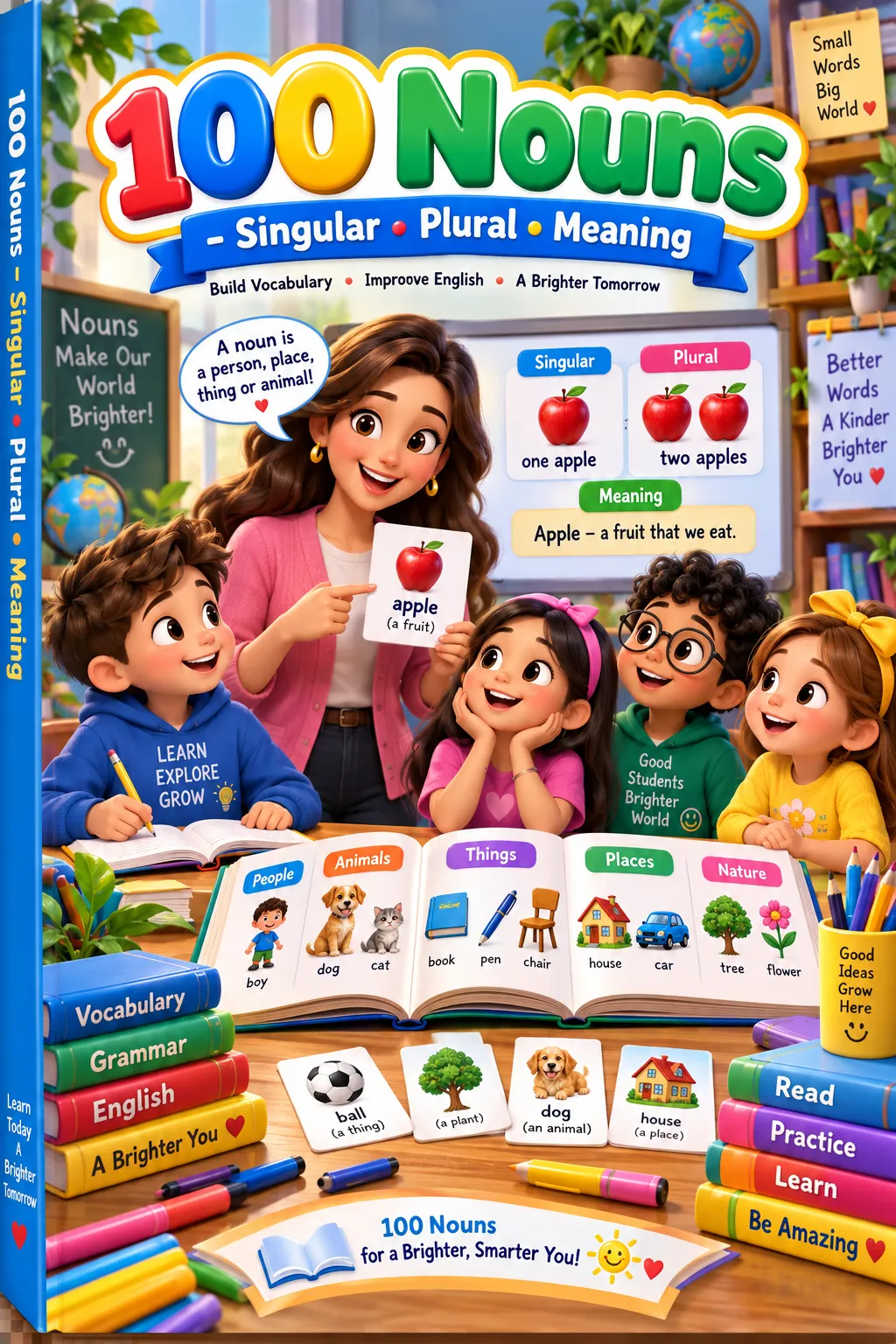
100 Nouns – Singular • Plural • Meaning
100 Nouns – Singular • Plural • Meaning is a practical English learning resource for students who want to understand nouns and their singular and plural forms. Learning noun number is an important part of English grammar because singular nouns generally refer to one person, place, animal, object, or idea, while plural nouns refer to more than one.
Learn Common Nouns Easily
100 Nouns – Singular • Plural • Meaning can help learners build a useful everyday vocabulary while understanding how nouns change from singular to plural. Common examples include book/books, pen/pens, teacher/teachers, and apple/apples. Learning these forms together makes it easier for students to recognize nouns when reading and use them correctly when writing.
For beginners, connecting each noun with its meaning can make vocabulary practice more effective. Students can read the singular form, learn its plural form, and then use both forms in simple sentences.
Understand Singular and Plural Forms
Most English nouns form the plural by adding -s, but some nouns require different spelling patterns. For example, nouns ending in sounds such as s, x, sh, and ch often take -es, as in bus/buses, box/boxes, and brush/brushes. Nouns ending in a consonant followed by y commonly change y to i before adding -es, such as city/cities and story/stories.
There are also irregular forms that students need to learn individually. Examples include man/men, woman/women, child/children, foot/feet, and mouse/mice. Some nouns, such as sheep and deer, can have the same form in both singular and plural contexts.
Improve Vocabulary and Sentence Building
100 Nouns – Singular • Plural • Meaning can be used for more than memorizing word pairs. Teachers and parents can encourage learners to create simple sentences with each noun. For example, students can describe one object using a singular noun and then describe several objects using the plural form.
This approach connects vocabulary with grammar and helps learners understand how nouns work naturally in sentences. It can also strengthen spelling, reading comprehension, and written communication.
Create a Simple Practice Routine
Students can practise 10 nouns at a time rather than trying to memorize all 100 at once. They can read each word aloud, cover the plural form and recall it, write the meaning, and then create a short sentence. Reviewing previously learned nouns every few days can also support long-term retention.
Teachers can turn the activity into a classroom game by asking students to match singular and plural cards or identify the correct plural form of a noun.
Final Thoughts
100 Nouns – Singular • Plural • Meaning offers a straightforward way to strengthen English vocabulary and grammar together. By learning common nouns, their plural forms, and their meanings, students can develop stronger foundations for reading, writing, speaking, and everyday English communication.